Showing posts with label sound design. Show all posts

Saturday, December 31, 2022

Director James Gray Emphasizes Sound as an Opportunity.

In the Nov/Dec 2022 issue of Post Magazine, Director James Gray (Armageddon Time, Ad Astra, The Lost City of Z) mentions audio when asked generally about opportunities in post-production:

"The thing about production sound is you can never reproduce all the magical little inflections of the actor on the day. [snip] Your performances have a greater authenticity."

"Dealing with sound and the mix is my favorite part of post.  Sound is half the experience and underrated, and I love the way a certain sound effect or an ambient track can change the whole mood of a scene.  [snip] It's how we really reach the audience subconsciously.  The audience is tremendously educated and advanced when it comes to visuals, maybe because of videogames and because it's a more obvious form of communication.  [snip] But I think our ears and all the audio processing is our biggest stealth weapon to get to your soul."


Thursday, March 25, 2021

Sound Designer Christopher Boyes on Mixing 'Pirates of the Caribbean'

Some interesting quotes on the sound of Pirates of the Caribbean: Dead Men Tell No Tales in the June 2017 issue "Post Magazine" from Re-Recording Mixer, Supervising Sound Editor, and Sound Designer Christopher Boyes:

"It's like a sonic dance.  You have to keep the momentum going, keep the emotion going with the music, and come in and out with the effects while constantly protecting the dialogue.  That is job number one."

"If I'm putting in a sound and it's not propelling the story forward, then it doesn't have a place.  Our editorial team supplies me with a tremendous amount of wonderful sonic assets but at the end of the day, more than 60 percent of them don't make it into the mix.  Once the effects become part of the entire experience they really get held to a very high standard as to whether or not they raise the track."

"I figure out which components of the ambience are actually complementing the music or the dialogue. The choice is scene specific.  If we are out on the ocean we have to have a little bit of wind, a sense of the ocean, a sense of the rigging and the sails, and the creaking ship.  You don't need all of that all of the time.  It's this constantly evolving landscape of sound effects that are folding in and out. Then for the big action sequences, all of those backgrounds disappear."

For action scenes, "[I will] poke the hard effects in and out, always with the notion of maintaining clarity on the track in an overall sense."

Working in 100-foot increments (about 1 minute), "we go through it an say, 'Do you hear that line?'  Are we hearing enough ocean?  Are we hearing enough of this or that?'  We challenge each other, and that is when we really fine-tune the mix."


Writer/Director Darius Marder on "Sound of Metal"

... artful approach to blending sound, cinematography, editing and production design ...

... use sound and its relationship to emotion.

... use sound design to create a point of view ... putting the audience inside the character's head ...

... developed ways to allow the audience to 'hear' through the character ...

"Deafness is not silence.  It's a different way of experiencing sound and vibration."

"We are constantly playing with the dichotomy of omnscient sound and perspective sound."


Tuesday, January 26, 2016

Alejandro González Iñárritu on the Importance of Sound in Movies

In an interview in the January 2016 issue of Post Magazine, Director Alejandro González Iñárritu provides his thoughts on the importance of sound in movies:

I think there’s a dictatorship of the image in all films, and I really like to challenge that. For me, sound is even more important than what you see on screen, in the way that it hits you. The emotional chords are much more sensitive to sounds than images, because they’re more abstract, and like smells they can trigger a much deeper understanding of things. When you see images, they’re very concrete. When you hear them, they’re abstract in the way they trigger your own emotional baggage. So I spend a lot of time looking for just the right sounds and textures for my films...

Sunday, August 3, 2014

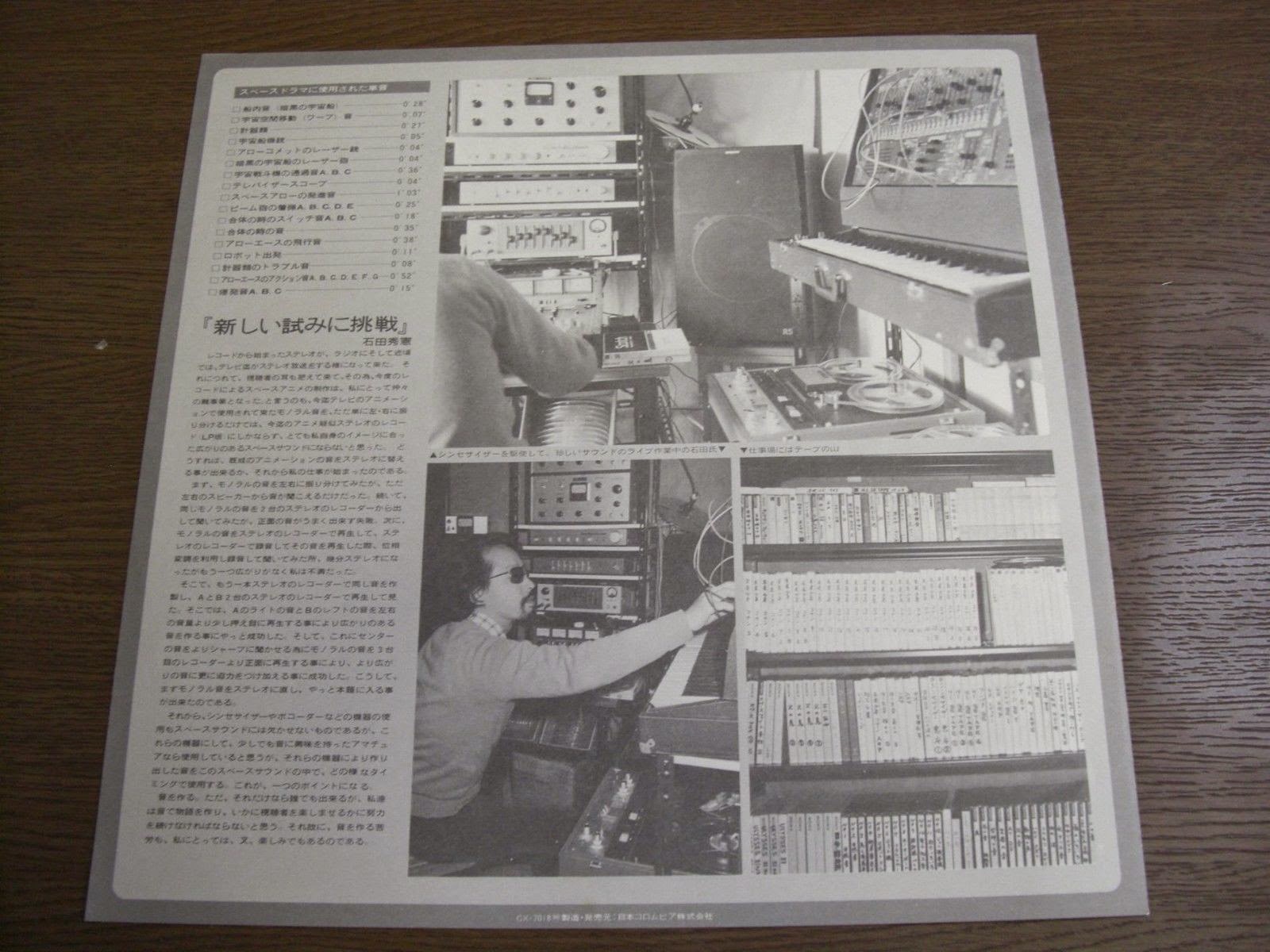
Sound Of Anime Ishida Hidenori LP Vinyl Record

Found these photographs of a sound effects LP called "Sound Of Anime Ishida Hidenori" on ebay.  Looks like an ARP 2600.  Ishida Hidenori is a giant in anime Sound Design, having founded Ishida Sound in 1971, which later became Fizz Sound Creation.  Wikipedia entry


You can see a photo of a bunch of their sound design audio tape reels on their current website:
http://www.fizz-sound.co.jp/.  The first ones have Dragon Ball written on the them!


Saturday, August 2, 2014

Walter Murch and The Search for Order in Sound & Picture

In the April 1998 issue of Mix Magazine, an article on the Godfather of Sound Design Walter Murch entitled "The Search for Order In Sound & Picture" is a great summary on his unique and over-arching views of aural theory and craft in movies.  Murch's approach has proven influential and thought-provoking to an entire industry, and there are just too many insights to post.  Instead, here's a link the article itself, a must read for everyone in Sound Design and Filmmaking.

http://www.filmsound.org/murch/waltermurch.htm

Wednesday, July 16, 2014

Tidbits Gary Dystrom's Interview With Mix Magazine 2004, Part 2

Part Two of the edited tidbits I noted from the interview with Sound Designer Gary Rydstrom in the February 2004 issue of Mix Magazine:

Sound comes to us over time. You don't get a snapshot of sound. Therefore, what you notice with sound, the essential building block, is change. So in... making a basic sound, I'm always thinking in terms of how it is changing over time. Even the simplest sound can have a rhythm to it, dynamics, changing pitch. Orchestrators must think about these things all the time.

So dynamics become a useful tool for getting a sense of contrast. In an action film, say Terminator 2, contrasts, sometimes even massive contrasts, are essential.  But it's also about how frequencies work together. There's a trick to making a gunshot big using multiple layers of elements. You take the high snap of a pistol and add to it the low boom of a cannon and the midrange of a canyon echo. You orchestrate it. On an über scale then, we do that to the whole soundtrack, making sounds work together.

I remember a scene in the first Mission Impossible in which Tom Cruise breaks into a computer room... for which we'd added all these sound details for equipment... Yet the idea was that if he made any sound... he would trip the alarm. Brian De Palma ultimately said, "No, take it all out." ...I went to see it with an audience and it had the desired effect: It made everyone lean in, pay closer attention, get nervous.

In a big action scene, the biggest challenge often is to make the track articulate. The mixing and editing challenge is to make the track not turn into mush.

On Cast Away ...there are stretches of that movie in which very little ...sound ...is used. And there's no music. No place to hide sounds, so they have to be the right sounds. Every detail becomes awfully important. 

Alan Splet (The Black Stallion, Eraserhead, The Elephant Man, Dune) was the best at using sound effects in an overtly psychological and musical way. His ambiences were stunning: applying rhythms and pitches of sounds as evocatively as a composer would.

Sometimes we'll get more punch from a mix by being less loud, by putting big moments in the proper context.

The sound process is a big funnel, narrowing tracks and making choices as it goes forward.


I agree, generally, with the trend to do sound jobs with a smaller core group of creative people who collaborate and cross over traditional roles.

Tidbits Gary Dystrom's Interview With Mix Magazine 2004, Part 1

Here are the edited tidbits I noted from the interview with Sound Designer Gary Rydstrom in the February 2004 issue of Mix Magazine:

On Cocoon, we had to do alien glow sounds... so I did the glass harmonica trick by rubbing my finger on the top of these glasses that meant a lot to me. A little echo and pitching and layering, and it became an alien glow sound.

I wanted to give the lamps in Luxo Jr. character through sound... I experimented with taking real sounds — a lot of it as simple as unscrewing a light bulb or scraping metal. Every once in a while, a sound would be produced that would remind you of sadness or glee. I always think of sound design being like prospecting for gold. Start by, say, goofing around, making lots of sounds, then find the one percent that has something interesting about it. Put this against the film, and there's a magical moment when the sound, if it's right, merges into the image, brings it to life.

With sampled sounds in RAM, you can instantly pitch-bend it and layer it and play it and shape it, without using any processing time. You can layer on the same key and very finely manipulate the pitch and delay and merge them together in ways that were harder to do in the tape-to-tape days. It allowed me to create the dinosaurs in Jurassic Park, in which I took several layers and blended different animal sounds into what sounds like one animal.

(To this day, I think the biggest advantage to the Synclavier is it's ability to so quickly pitch individual sounds in a layer for tuning.)

When we cut on mag... we had three dubbers available. We could cut up to three tracks — very limited. But you learned to work within this limitation ...if you go right to Pro Tools, you have almost too many possibilities right out of the gate; it's harder to focus on the essence of what sound editing is through all the bells and whistles.

I remember on Saving Private Ryan, I was trying to come up with weird sounds for these incoming tanks as they approached the village. Spielberg wanted scary, odd sounds bouncing between the buildings. I put sounds of metal scraping and engines beating on quarter-inch tape and rocked the tape back and forth by hand — like record scratching — and coming up with strange sounds and rhythms. I could only do that with a quarter-inch tape deck.

There has been no revolution in sound to parallel the revolution in visuals in the last 10 years... I can't go into a computer that I know of and create a lion roar, synthesize it entirely and make it a believable, interesting lion like ILM can make a lion. I would think that creating a lion visually is harder than creating a lion roar, but I guess I'm wrong.

Sunday, July 13, 2014

Sound Design on Disney's Dinosaur

This article I saved from the print publication Mix Magazine is now online. 

http://mixonline.com/mag/audio_dinosaur_disney_chris/

Lemurs:
- penguins for whoops for excited movement
- a fox named Socks the Fox for mournful yips and yaps for happy and sad Lemurs
- capuchin (a type of monkey) for chirps
- human vox for happy bellows

Raptors:
- 10-year-old Chihuahua with emphysema (trills and growls for menace) + goose hisses + yellow-blackbird caws

Carnotaur:
- pissed leapord in Florida (mic'd close for guttural, wet snarls, breaths, and chuffs) + elephant for regal, growling sound
- leopard + large boar + macaw for high shrieking element for terror


Monday, June 10, 2013

Danny Boyle on Sound and Music for Trance

In the May 2013 issue of Post Magazine, Director Danny Boyle comments on the importance of sound and music for his latest film, Trance:


"POST:  As usual, the sound and music are also key elements in this film.

BOYLE: “They’re hugely important to me as a filmmaker. I actually believe — and we don’t realize this as an audience — that it’s at least 70 percent of a film, if not more. If you have bad sound, any movie is unwatchable, and if you turn the sound off on any film, most are also unwatchable. They just don’t work. It’s extraordinary, and sound recordists often get treated so badly on sets, even though the audio is so vital. But if you have a film with bad visual quality, you can get away with it.  In fact, your eye adapts quite quickly.  28 Days Later, for instance, was a very rough-looking film deliberately, and it didn’t faze anyone.  But there’s no way around bad sound. If you can’t hear dialogue and so on, it’s a disaster.  The opposite side is just how effective a film can become when you have really good use of sound..."

Thursday, May 24, 2012

In the May 1, 2012 issue of Post Magazine, when asked about audio in his movies, Director Barry Sonnenfeld states, "I remember the first film I ever shot as a DP was Blood Simple for the Coen brothers, and they’re very visual, but when it came time to choose a New York theater for the premiere, they chose a theater with much better sound but lousier projection, as opposed to one with great projection and lousy sound.  As the DP I was outraged!  But the truth is, if you asked me right now to choose between screening MIB3 in a theater with better sound or one with better projection, I’d pick the one with the better sound.  So sound’s really important to me."

Monday, April 23, 2012

Opera and Sound Design

German Operatic Tenor Jonas Kaufmann made some intriguing remarks in this interview.  He says the human voice "is not only the oldest and most versatile instrument but also the most natural instrument of music, as it is inside of us. We can influence this instrument via our thoughts and feelings in such a strong way that we can hear within a split second, whether somebody is happy, sad, or incensed."  On knowing reasons why something moves us, he says, "For me it is very fascinating that a pop song that was a number-one-hit some 20 or 30 years ago is of interest today merely for nostalgic reasons.  If people are touched by it for sentimental reasons, then it is in most cases not because of the music itself, but rather because of personal memories that are connected to it."

Sound Designers are often asked by someone to make something sound like this or that from some movie that person watched a long time ago.  Does he believe his reference to be amazingly cool because it is, in and of itself?  Or is it because of some non sound design related personal memory associated with it?  I think many times, even for Sound Designers, it is the latter.