Saturday, December 31, 2022

Director James Gray Emphasizes Sound as an Opportunity.

In the Nov/Dec 2022 issue of Post Magazine, Director James Gray (Armageddon Time, Ad Astra, The Lost City of Z) mentions audio when asked generally about opportunities in post-production:

"The thing about production sound is you can never reproduce all the magical little inflections of the actor on the day. [snip] Your performances have a greater authenticity."

"Dealing with sound and the mix is my favorite part of post.  Sound is half the experience and underrated, and I love the way a certain sound effect or an ambient track can change the whole mood of a scene.  [snip] It's how we really reach the audience subconsciously.  The audience is tremendously educated and advanced when it comes to visuals, maybe because of videogames and because it's a more obvious form of communication.  [snip] But I think our ears and all the audio processing is our biggest stealth weapon to get to your soul."


Thursday, March 25, 2021

Sound Designer Christopher Boyes on Mixing 'Pirates of the Caribbean'

Some interesting quotes on the sound of Pirates of the Caribbean: Dead Men Tell No Tales in the June 2017 issue "Post Magazine" from Re-Recording Mixer, Supervising Sound Editor, and Sound Designer Christopher Boyes:

"It's like a sonic dance.  You have to keep the momentum going, keep the emotion going with the music, and come in and out with the effects while constantly protecting the dialogue.  That is job number one."

"If I'm putting in a sound and it's not propelling the story forward, then it doesn't have a place.  Our editorial team supplies me with a tremendous amount of wonderful sonic assets but at the end of the day, more than 60 percent of them don't make it into the mix.  Once the effects become part of the entire experience they really get held to a very high standard as to whether or not they raise the track."

"I figure out which components of the ambience are actually complementing the music or the dialogue. The choice is scene specific.  If we are out on the ocean we have to have a little bit of wind, a sense of the ocean, a sense of the rigging and the sails, and the creaking ship.  You don't need all of that all of the time.  It's this constantly evolving landscape of sound effects that are folding in and out. Then for the big action sequences, all of those backgrounds disappear."

For action scenes, "[I will] poke the hard effects in and out, always with the notion of maintaining clarity on the track in an overall sense."

Working in 100-foot increments (about 1 minute), "we go through it an say, 'Do you hear that line?'  Are we hearing enough ocean?  Are we hearing enough of this or that?'  We challenge each other, and that is when we really fine-tune the mix."


Writer/Director Darius Marder on "Sound of Metal"

... artful approach to blending sound, cinematography, editing and production design ...

... use sound and its relationship to emotion.

... use sound design to create a point of view ... putting the audience inside the character's head ...

... developed ways to allow the audience to 'hear' through the character ...

"Deafness is not silence.  It's a different way of experiencing sound and vibration."

"We are constantly playing with the dichotomy of omnscient sound and perspective sound."


Tuesday, January 3, 2017

Pearls of Wisdom from Ridley Scott and Warren Beatty

Several mentionables in separate interviews with Director Ridley Scott and Director/Actor Warren Beatty in the December 2016 issue of Post Magazine:

Scott:  For me, if you didn’t get it in the camera, you’re going to have serious problems and issues in post. You can’t save a movie in post, no matter how many visual effects you stuff it with.
The phrase "we'll fix it in post" gets tossed around a lot, but there's just only so much that can be done on the post-production end.  Try your hardest to make things right in production.  But how does one know what's right in production?  Experience, wisdom, expertise, and clarity of what's to be accomplished — Scott discusses this later in the interview:
Scott:  If you know what you’re doing you don’t need to spend all that time... For me, speed is good. It stops you over-thinking things.

Sounds like he's done plenty of experimentation, and often he knows exactly what he wants and how to achieve it, no more no less.  Laser focused efficiency.  On the flip side, Warren Beatty mentions how unplanned spontaneity can also be beneficial:

Beatty:  A film never turns out the way you first envision it. And you hope it doesn’t, because it gets better as you go along — or it should... I had all these initial ideas in mind, but sometimes you do your best work when you don’t have anything in mind and it just happens when you’re thinking about something else.

On watching and showing their work:

Scott:  I never watch any long-form version of my films till we have it all cut and put together. So you’re a virgin and you watch it fresh.
When creating, try to experience it with a first-impression mentality so you can critique and improve it properly for your audience.  Do not let your familiarity with the material equate to clarity of the material.  Beatty talks about another aspect of immediacy:

Beatty:   I don’t like to show a film before it’s ready, because with my films, they only get ready at the last minute. To quote Cocteau, ‘A poem’s never finished, it’s just abandoned,’ and that’s how I feel. I like showing it but not to people who then have to decide what they think of it. That’s dangerous, and you only have one immediate response.

When asked his opinion on music and sound being half the movie, Beatty responds:

I wouldn’t say half. I’d say more like 95 percent. (Laughs) It’s just so important and I choose all the music myself.

Saturday, October 8, 2016

Interesting BBC Article On Influencing Public Behavior

Interesting read on the successful experimentation of exploiting psychological quirks to influence public behavior backed up by using metrics and analytics similar to those used in casual game developement.

http://www.bbc.com/future/story/20161006-how-a-few-words-can-make-people-hand-over-millions


Tuesday, January 26, 2016

Alejandro González Iñárritu on the Importance of Sound in Movies

In an interview in the January 2016 issue of Post Magazine, Director Alejandro González Iñárritu provides his thoughts on the importance of sound in movies:

I think there’s a dictatorship of the image in all films, and I really like to challenge that. For me, sound is even more important than what you see on screen, in the way that it hits you. The emotional chords are much more sensitive to sounds than images, because they’re more abstract, and like smells they can trigger a much deeper understanding of things. When you see images, they’re very concrete. When you hear them, they’re abstract in the way they trigger your own emotional baggage. So I spend a lot of time looking for just the right sounds and textures for my films...

Sunday, August 3, 2014

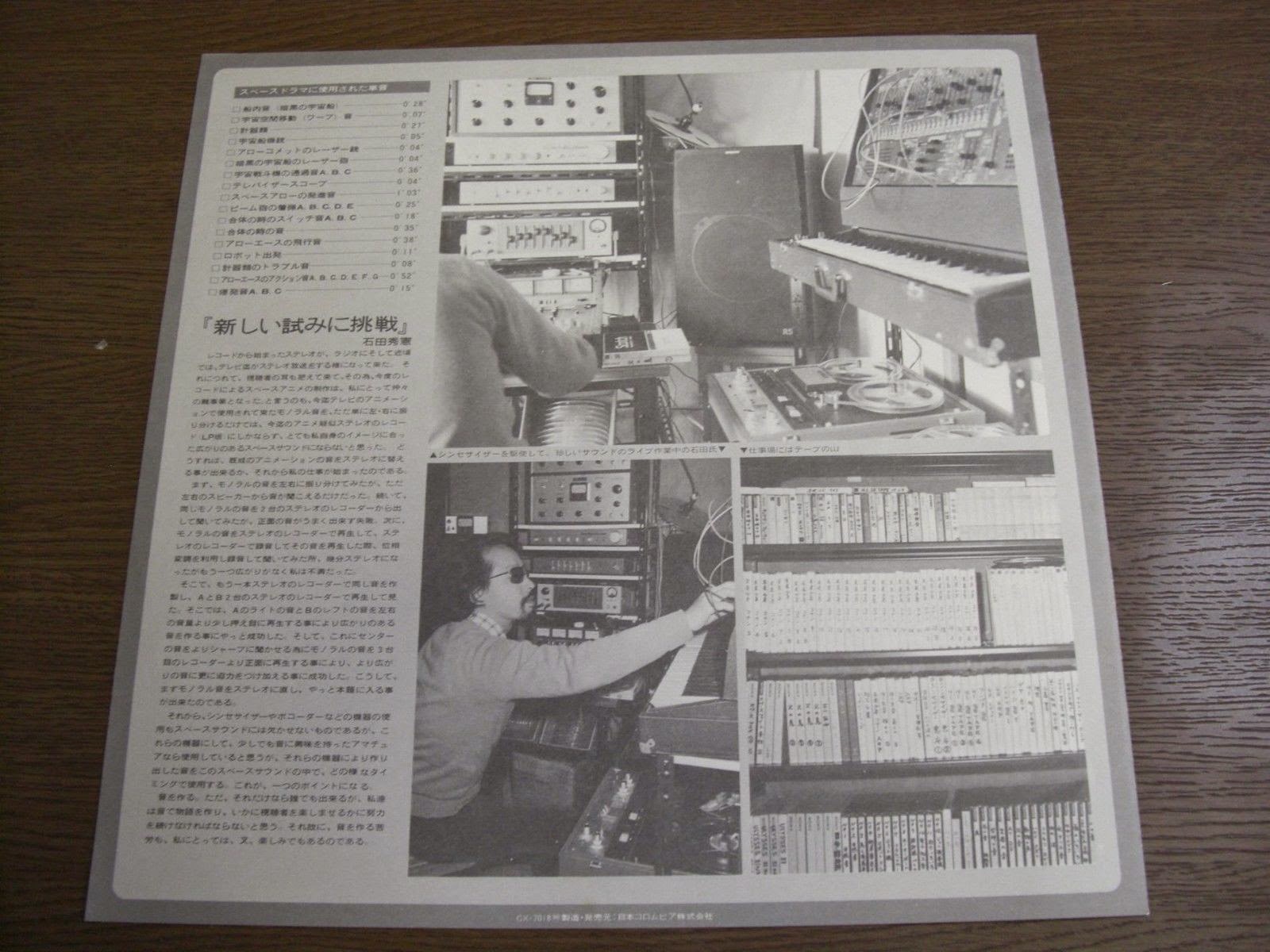
Sound Of Anime Ishida Hidenori LP Vinyl Record

Found these photographs of a sound effects LP called "Sound Of Anime Ishida Hidenori" on ebay.  Looks like an ARP 2600.  Ishida Hidenori is a giant in anime Sound Design, having founded Ishida Sound in 1971, which later became Fizz Sound Creation.  Wikipedia entry


You can see a photo of a bunch of their sound design audio tape reels on their current website:
http://www.fizz-sound.co.jp/.  The first ones have Dragon Ball written on the them!


Saturday, August 2, 2014

Walter Murch and The Search for Order in Sound & Picture

In the April 1998 issue of Mix Magazine, an article on the Godfather of Sound Design Walter Murch entitled "The Search for Order In Sound & Picture" is a great summary on his unique and over-arching views of aural theory and craft in movies.  Murch's approach has proven influential and thought-provoking to an entire industry, and there are just too many insights to post.  Instead, here's a link the article itself, a must read for everyone in Sound Design and Filmmaking.

http://www.filmsound.org/murch/waltermurch.htm

Friday, August 1, 2014

Director Jim Sheridan On Simple Shots

In the February 2004 issue of Millimeter Magazine, Director Jim Sheridan (My Left Foot), discusses simple, clean shots in his movies:

I think it's better to have a lack of visual information than to have too much.  When you have a lack of information the audience has to become interactive with it.  They have to figure out what they're looking at.  I think a lot of films are overcrowded with information.  There's too much going on: too much light, too much acting, too much story.

...The more you put in the way that is visible, the less chance you have of getting true emotions.

Some movies spend an awful lot of time on carefully planned shots where everybody hits their marks, and it looks great.  But working that way can also take the soul out of a show.

If the audience is watching the characters and focused on the story, they're more likely to get the emotion of the moment.  The less you put in the way of that, the better.

Thursday, July 31, 2014

Randy Thom Interview, April 2005

In the April 2005 issue of Film & Video Magazine, there's an interview with Sound Designer Randy Thom called "What Randy Thom Hears."  Here are some quotables:

In an action sequence, the impression you want to give the audience, typically, is that they’re hearing 50 things at once — people screaming, gunshots, explosions, the score, etc. But if you actually play all of those sounds at an equal volume, it turns into incoherent noise. The trick is to decide what you want the audience to focus on and use various audio tricks to allow them to focus on those sounds to the exclusion of everything else. Sometimes it’s as simple as raising the volume on the thing you want them to focus on and lowering the volume of everything else. Sometimes you change the tonal character of the principal sound and what you want to be the background sounds. If you do it artfully enough, the audience gets the impression that it’s hearing everything all the time. But if you analyze it, what you’re hearing is a carefully orchestrated changing of focus from moment to moment, from this to that.

In reality, everything that we hear in our environments has an emotional effect on us.

...when you’re a filmmaker and a sound designer, you should be thinking about the story and about using sound in the smartest possible ways to help tell the story and not be obsessed with 5.1 and 7.1 and all that. Because I would, and most people with a brain would, rather watch and listen to a great movie in mono than a thoroughly mediocre movie in 20.1 if such a thing existed. All of that stuff, being able to pan sounds around the room and having lots of subwoofer, is the icing on the cake. And first you have to get the cake, and too many movies these days don’t start with a very good cake.
 

Sunday, July 27, 2014

Production Sound Mixer Jeff Wexler Interview, Mix Magazine 2005

The April 2005 issue of Mix Magazine has a great interview with Production Sound Mixer Jeff Wexler.  Great wisdom on managing people and their expectations in the sound business.  Some enlightening thoughts:

If you very specifically define people's tasks, things will, hopefully, go more smoothly. But the way that hurts is that people often have more to offer.

On Director Hal Ashby:

He was one of the most collaborative people of anyone I've worked with, open to suggestions and ideas from anyone and very unthreatened about it... it helped me to do sound because it made me feel involved in the whole project. 

...grandstanding never accomplishes anything productive. It just causes animosity toward the sound department. Flamboyance went out of my repertoire years ago. Now I deal with things quietly, usually with a conversation early on, where we set rules and protocol and whether if a director is getting into trouble and I have a solution I should bring it to him or her.

Boom is absolutely the key position in the production sound department... They have to be listening with an experienced ear and have the ability to put the microphone in a place where it picks up the voice in a beautiful way and gets rid of the things you don't want to record.

...a lot of people are doing their job for the first time without an understanding of the discipline and with the protective arrogance that can sometimes accompany that.

We've gained the ability to shoot a lot of film and record a lot of tracks, but we've lost the sort of focus that needs to happen before you film.

On the Schoeps MK 41 supercardioid capsule with the CMC amplifier he uses:

We did tests with a shotgun mic and with the Schoeps and the Schoeps sounded like the real world. You heard the background, but in a coherent way that made sense. The extremely directional mics cut down the level of the background, but also negatively affected the sound of the voices.

Equipment comes and goes... If you haven't established the necessary skills, personal relationships and clarity of thought in your approach to your work, all the latest equipment won't amount to anything.

Wednesday, July 23, 2014

Quentin Tarantino on the Importance of Music in His Films

In the April 2007 issue of Post Magazine, Quentin Tarantino explains that music is hugely important to his films.

"...I actually figure out a lot of the music before I start shooting.  It's actually part of the hook that commits me to doing a film."

Tuesday, July 22, 2014

Tom Holman's musings on Walter Murch, Ben Burtt, and Skywalker Sound.

In an old article in Surround Professional magazine entitled "Something in the Water" Tom Holman writes about the pedigree of Skywalker Sound and its Sound Designers.  Some highlights:

On Walter Murch isms:

"Sound is like a three-ring circus; you don't find any five-ring circuses because the mind can't follow five things at once"; "Sound comes in the back door, while picture comes in the front; so sound has a subtle storytelling character about it that can be used to move an audience in certain ways without their conscious knowledge, and the corollary to that 'sound people will never get the recognition they deserve'"; and "We can think about sound as having a sharp foreground and an out-of-focus background, just like a camera does" (Side note: this shallow depth of field effect is achieved by opening up the iris, but lenses aren't always set up this way.  Citizen Kane is well-known for being shot with a deep depth of field).  These are paraphrases of classic Murch concepts, except the recognition issue corollary, which is added.

And then came Ben Burtt.  Hired out of USC by George [Lucas] about a year before Star Wars came out, it was certainly unusual to start on sound a year ahead of release.

Sound Can Improve Picture Quality

In the January 2005 edition of Videography Magazine, Mark Schubin in his article "More Than Just Numbers" writes:

Sound may not seem to have anything to do with picture quality, but don’t be too hasty to come to that conclusion.  Lincoln Center for the Performing Arts conducted experiments in the 1970s in which focus groups that heard stereo sound with certain programs rated the picture quality higher than groups who saw the same programs without stereo sound.

Why Movie Mixes Don't Translate Into The Home

In an old article in Surround Professional magazine (I believe it's in the April 2002 edition) titled "Scaling the Experience: Considerations for Bringing Movie Sound Into Homes," Tom Holman explains why mixes in the theatrical dub stage don't translate into typical home theaters.

Theater mixes played at the same physical sound pressure level at home are perceived as much louder.  "This is due to a psychoacoustic scaling function: we come to 'expect' certain sound levels in certain spaces."

Best movie theater listening seats are between 50 and 70 percent of the critical distance (the distance from a source along its axis where the level of the direct sound and reverberant sound from the source are equal).  He's saying dub stage listening positions are dryer because "cinemas are much deader for their room volume than other spaces" and "use directional screen loudspeakers," counter to what we typically think of for large reverberant spaces like churches and halls.  For a typical 3000 cu. ft. living room (approximately 20'x20'x8'), the combination of reverberation time and lack of speaker directionality (he mentions the fronts are "direct radiators"), the listening position is the equivalent of 1.8 times the critical distance, so much wetter compared to the 0.5 to 0.7 times the critical distance of theaters.  Much of the translation problem is therefore attributed to the theater listening position being direct field dominated and the home being reverberant field dominated.

Another issue is that in the home, speakers are more directional at higher frequencies, where reverberation times fall, causing the soundfield to "reach out and touch you."  Material mixed on the mixing stage will thus sound brighter in the living room.

Good stuff!

Saturday, July 19, 2014

To Determine Appropriate Loudness Use Speech Not Footsteps!

There's an interesting chart on loudness in "Intelligent Program Loudness Measurement and Control: What Satisfies Listeners?" presented at the 115th AES Convention in 2003: 


When listeners were asked to evaluate what they felt were appropriately loud in speech, 19 out of 21 were within 1dB of each other. When asked to evaluate footsteps, they disagreed with each other up to 12dB! I think even among audio professionals who mix for a living, there are wide differences in what the appropriate loudness levels of footsteps (and Foley, sound effects, and music) are.

Thursday, July 17, 2014

Luc Besson On Sound and Music For Film

In the June 2007 issue of Post Magazine, Director Luc Besson (La Femme Nikita, The Fifth Element) talks about music and audio for his films:

They're huge and so important to me... I really enjoy pulling all that together because it can change what you see on the screen so much.  I was probably the first one in France, 30 years ago, to care for sound and music so much.  When I began, French directors didn't care much about it.

On music:

I saw very early on how it's this amazing tool that allows you to say so many things when it's placed with an image.  So you have the story, the dialogue, the actor's performances, the frame -- and you still have so much room for the music and the sound effects...

Wednesday, July 16, 2014

Tidbits Gary Dystrom's Interview With Mix Magazine 2004, Part 2

Part Two of the edited tidbits I noted from the interview with Sound Designer Gary Rydstrom in the February 2004 issue of Mix Magazine:

Sound comes to us over time. You don't get a snapshot of sound. Therefore, what you notice with sound, the essential building block, is change. So in... making a basic sound, I'm always thinking in terms of how it is changing over time. Even the simplest sound can have a rhythm to it, dynamics, changing pitch. Orchestrators must think about these things all the time.

So dynamics become a useful tool for getting a sense of contrast. In an action film, say Terminator 2, contrasts, sometimes even massive contrasts, are essential.  But it's also about how frequencies work together. There's a trick to making a gunshot big using multiple layers of elements. You take the high snap of a pistol and add to it the low boom of a cannon and the midrange of a canyon echo. You orchestrate it. On an über scale then, we do that to the whole soundtrack, making sounds work together.

I remember a scene in the first Mission Impossible in which Tom Cruise breaks into a computer room... for which we'd added all these sound details for equipment... Yet the idea was that if he made any sound... he would trip the alarm. Brian De Palma ultimately said, "No, take it all out." ...I went to see it with an audience and it had the desired effect: It made everyone lean in, pay closer attention, get nervous.

In a big action scene, the biggest challenge often is to make the track articulate. The mixing and editing challenge is to make the track not turn into mush.

On Cast Away ...there are stretches of that movie in which very little ...sound ...is used. And there's no music. No place to hide sounds, so they have to be the right sounds. Every detail becomes awfully important. 

Alan Splet (The Black Stallion, Eraserhead, The Elephant Man, Dune) was the best at using sound effects in an overtly psychological and musical way. His ambiences were stunning: applying rhythms and pitches of sounds as evocatively as a composer would.

Sometimes we'll get more punch from a mix by being less loud, by putting big moments in the proper context.

The sound process is a big funnel, narrowing tracks and making choices as it goes forward.


I agree, generally, with the trend to do sound jobs with a smaller core group of creative people who collaborate and cross over traditional roles.

Tidbits Gary Dystrom's Interview With Mix Magazine 2004, Part 1

Here are the edited tidbits I noted from the interview with Sound Designer Gary Rydstrom in the February 2004 issue of Mix Magazine:

On Cocoon, we had to do alien glow sounds... so I did the glass harmonica trick by rubbing my finger on the top of these glasses that meant a lot to me. A little echo and pitching and layering, and it became an alien glow sound.

I wanted to give the lamps in Luxo Jr. character through sound... I experimented with taking real sounds — a lot of it as simple as unscrewing a light bulb or scraping metal. Every once in a while, a sound would be produced that would remind you of sadness or glee. I always think of sound design being like prospecting for gold. Start by, say, goofing around, making lots of sounds, then find the one percent that has something interesting about it. Put this against the film, and there's a magical moment when the sound, if it's right, merges into the image, brings it to life.

With sampled sounds in RAM, you can instantly pitch-bend it and layer it and play it and shape it, without using any processing time. You can layer on the same key and very finely manipulate the pitch and delay and merge them together in ways that were harder to do in the tape-to-tape days. It allowed me to create the dinosaurs in Jurassic Park, in which I took several layers and blended different animal sounds into what sounds like one animal.

(To this day, I think the biggest advantage to the Synclavier is it's ability to so quickly pitch individual sounds in a layer for tuning.)

When we cut on mag... we had three dubbers available. We could cut up to three tracks — very limited. But you learned to work within this limitation ...if you go right to Pro Tools, you have almost too many possibilities right out of the gate; it's harder to focus on the essence of what sound editing is through all the bells and whistles.

I remember on Saving Private Ryan, I was trying to come up with weird sounds for these incoming tanks as they approached the village. Spielberg wanted scary, odd sounds bouncing between the buildings. I put sounds of metal scraping and engines beating on quarter-inch tape and rocked the tape back and forth by hand — like record scratching — and coming up with strange sounds and rhythms. I could only do that with a quarter-inch tape deck.

There has been no revolution in sound to parallel the revolution in visuals in the last 10 years... I can't go into a computer that I know of and create a lion roar, synthesize it entirely and make it a believable, interesting lion like ILM can make a lion. I would think that creating a lion visually is harder than creating a lion roar, but I guess I'm wrong.

Tom Tykwer Talks Sound and Music

In the January 2007 issue of Post Magazine online, Director Tom Tykwer (Run Lola Run, Cloud Atlus) discusses his approach to sound and music for his movies.  There's more of his conversation in the print issue.  Here are some of the bits paraphrased:

The musical aspect of film in general is of course something that relates much more to the abstract relationship leading us to emotional perception. We were trying to establish a movie that somehow, not only through the sound but through the way that sound and image are intertwined, gives us a certain feeling: it's how the person the film is describing actually experiences the world.

For us, the music has to start first. I'm already starting to compose while I'm working on the script. We start composing alongside the script, so we find the sound in terms of the music of the film while we're in the writing process. When we arrive on set, we already have a substantial part of the music composed, and we've hired a small orchestra to play it for us, so we can really play it to the actors and get it 'into the scenery' of the actual shooting, as it were. So people could already explore the atmosphere and the acoustic world of the film while they were acting in it.

Sound design is often appreciated in films that create a lot of noise, but I'm a big admirer of the quiet movies. I know how difficult it is to mix a convincingly quiet film, because quietness has so many levels. It's much easier to produce a very loud, effects-driven and music-overloaded movie. I remain a fan of films that were made in the very early days of sound design and that can still deliver interesting results. The Exorcist, for example, has an amazing soundtrack, and in more modern times, what David Fincher does is really impressive. The entire suspense of his film Seven is really built through the soundtrack, with music and sound so well intertwined.