Thursday, September 9, 2010
Emerging Markets now available to 529 plans
It's been impossible to customize the allocation of Emerging Markets in a 529 college savings plan portfolio... until now. You can now invest in the iShares MSCI Emerging Markets Portfolio (EEM) via the Arkansas/iShares 529 Plan. Downside? A 1.10% annual fee, ouch! Compare that to Vanguard's Emerging Markets Stock ETF (VWO) at 0.27% which also has better tracking. Granted, there would be a markup for 529 administration and the sponsoring state, but it would still be about half of what the iShares version costs. Well at least we have the option now...

Sound Speak - Phillip Noyce on the Audio of Salt
Excertps from Phillip Noyce as he talks about the sound of his movie "Salt" from the August 2010 Mix Magazine article.
“In this particular film, music drives the soundtrack, and that’s quite unusual for an action film, where usually it’s the effects that drive the sound. The reason music drives the film is because I’ve used James Newton Howard’s score as the unifying factor to combine what is on the one hand fantastical, escapist popcorn entertainment, and on the other hand, a fact-based thriller—two seemingly irreconcilable genres that are pulled together and held tight by James’ score. Everything, in a sense, was subordinated to the music.”
“I’ve always believed in using sound as an ‘emotionator,’ if I can make up a word,” Noyce laughs. “No sound is innocuous, no musical note is innocuous. They simply exist. Whether it’s the rustle of the wind, the sound of birds, the footsteps or the strings, they all have a dramatic and an emotional purpose within the soundtrack.
“We set out at the beginning of the sound work with a number of objectives,” he continues. “One was to ensure that as a ride, Salt is relentless. Once the audience gets on, we want the roller coaster to never stop. The audience has nowhere to hide, you just hold on and hope you get to the end with your brain intact. That means you are trying to create incessant rhythms of sound. There can be no pause. You’re trying to hit them and hit them and hit them as if you have them against a wall, punching them. But you want them to feel as if you’re just stroking them, because you want them on the edge of their seats wanting more. Every time they might want to feel like a pause, there’s another sound ricocheting into the next sound, that’s bouncing forward into the next one. And they keep going within a rhythm that’s relentless. The trick is to find the right level, and I don’t mean volume. I mean the right level of complexity without ever being bombastic.”
“In this particular film, music drives the soundtrack, and that’s quite unusual for an action film, where usually it’s the effects that drive the sound. The reason music drives the film is because I’ve used James Newton Howard’s score as the unifying factor to combine what is on the one hand fantastical, escapist popcorn entertainment, and on the other hand, a fact-based thriller—two seemingly irreconcilable genres that are pulled together and held tight by James’ score. Everything, in a sense, was subordinated to the music.”
“I’ve always believed in using sound as an ‘emotionator,’ if I can make up a word,” Noyce laughs. “No sound is innocuous, no musical note is innocuous. They simply exist. Whether it’s the rustle of the wind, the sound of birds, the footsteps or the strings, they all have a dramatic and an emotional purpose within the soundtrack.
“We set out at the beginning of the sound work with a number of objectives,” he continues. “One was to ensure that as a ride, Salt is relentless. Once the audience gets on, we want the roller coaster to never stop. The audience has nowhere to hide, you just hold on and hope you get to the end with your brain intact. That means you are trying to create incessant rhythms of sound. There can be no pause. You’re trying to hit them and hit them and hit them as if you have them against a wall, punching them. But you want them to feel as if you’re just stroking them, because you want them on the edge of their seats wanting more. Every time they might want to feel like a pause, there’s another sound ricocheting into the next sound, that’s bouncing forward into the next one. And they keep going within a rhythm that’s relentless. The trick is to find the right level, and I don’t mean volume. I mean the right level of complexity without ever being bombastic.”
Sunday, April 4, 2010
Use Dialog to Calibrate Loudness
In the 115th AES Convention paper "Intelligent Program Loudness Measurement and Control: What Satisfies Listeners?" 19 of 21 listeners agreed with each other to within 1dB when evaluating the subjective loudness of speech. However, they disagreed when asked what constitutes "appropriate" loudness for footsteps. Also in the paper, TV listeners preferred dialog at 60.5 dB SPL versus 69 dB in home theaters. Normal conversational speech fall in the range of 55 to 66 dB SPL. All SPL is measured at A-weighted, slow.
Wednesday, March 24, 2010
Stock Market Capitalization Performance On Key Dates Since October 2007
Austria and Kuwait have both done horribly -- value! Colombia and Qatar - resiliency! Indonesia and India on a tear -- momentum!
https://spreadsheets.google.com/ccc?key=0AjFjvvkp-He7dGpSQ29yMU5RcjZ1ZE1GZXVNNVJlTUE&hl=en
https://spreadsheets.google.com/ccc?key=0AjFjvvkp-He7dGpSQ29yMU5RcjZ1ZE1GZXVNNVJlTUE&hl=en
Tuesday, March 9, 2010
No Market Timing Newsletters Called The Tops Or Bottoms Of The Last Decade
A recent article mentions that of the hundreds of market timing newsletters that the Hulbert Financial Digest tracks, none were able to call the market top or bottom of the last year, or for that matter the major tops/bottoms of the last decade. This is even amidst loose definitions of what "calling" means. It just goes to show that timing the market is EXTREMELY difficult to do, even by those that make a living off of it.
Friday, January 29, 2010
Annual Returns By Asset Class 1999 to 2009

A great chart from Research Affiliates in this article "Was It Really A Lost Decade?" "EW Asset Classes" stands for equally weighting the asset classes in a portfolio. Perhaps a good starting point to decide on your own asset allocation?
Wednesday, January 6, 2010
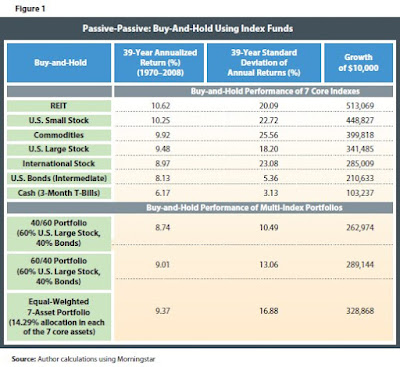
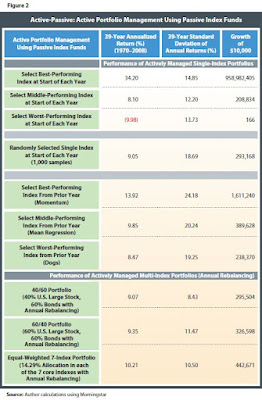
Performance of an Equally-Weighted Portfolio Annually Rebalanced from 1970-2008
Dr. Craig Israelsen is out with another well-documented article "Actively Passive" in the first 2010 issue of the Journal of Indexes. In it, he notes that an equally-weighted portfolio of 7 assets rebalanced annualy had a 39-year annualized return of 10.21% from 1970-2008, outperforming various other investigated "actively passive" strategies except for one: selecting the best-performing index from the prior year (a kind of momentum investing) which returned 13.92% annually, but with nearly 2.5x more volatility. I'm thinking the best bang-for-your-buck strategy for an individual investor is to half utilize a similarly weighted portfolio that's tweaked a bit more towards international and emerging markets, half utilize a momentum strategy (if one can stomach that roller coaster ride), rebalance when things get too far awry (but not too frequently), utilize a moving-average crossover system for risk management (or temporal diversification) similar to those discussed by Mebane T. Faber and Theodore Wong, and all the while keeping a close eye on costs (transaction fees and taxes). That'll do pig, that'll do.


Subscribe to:
Posts (Atom)