Austria and Kuwait have both done horribly -- value! Colombia and Qatar - resiliency! Indonesia and India on a tear -- momentum!
https://spreadsheets.google.com/ccc?key=0AjFjvvkp-He7dGpSQ29yMU5RcjZ1ZE1GZXVNNVJlTUE&hl=en
Wednesday, March 24, 2010

Tuesday, March 9, 2010
No Market Timing Newsletters Called The Tops Or Bottoms Of The Last Decade
A recent article mentions that of the hundreds of market timing newsletters that the Hulbert Financial Digest tracks, none were able to call the market top or bottom of the last year, or for that matter the major tops/bottoms of the last decade. This is even amidst loose definitions of what "calling" means. It just goes to show that timing the market is EXTREMELY difficult to do, even by those that make a living off of it.
Friday, January 29, 2010
Annual Returns By Asset Class 1999 to 2009

A great chart from Research Affiliates in this article "Was It Really A Lost Decade?" "EW Asset Classes" stands for equally weighting the asset classes in a portfolio. Perhaps a good starting point to decide on your own asset allocation?
Wednesday, January 6, 2010
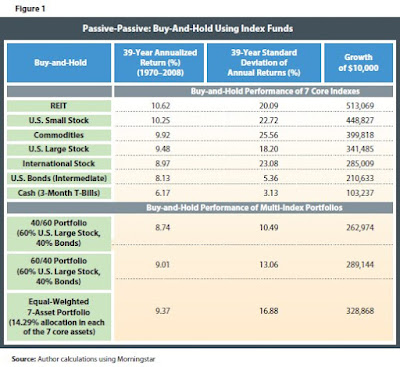
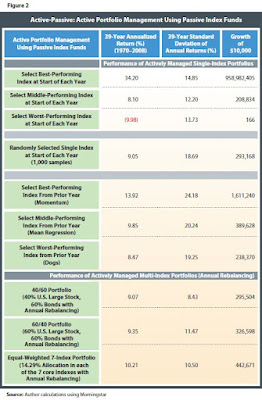
Performance of an Equally-Weighted Portfolio Annually Rebalanced from 1970-2008
Dr. Craig Israelsen is out with another well-documented article "Actively Passive" in the first 2010 issue of the Journal of Indexes. In it, he notes that an equally-weighted portfolio of 7 assets rebalanced annualy had a 39-year annualized return of 10.21% from 1970-2008, outperforming various other investigated "actively passive" strategies except for one: selecting the best-performing index from the prior year (a kind of momentum investing) which returned 13.92% annually, but with nearly 2.5x more volatility. I'm thinking the best bang-for-your-buck strategy for an individual investor is to half utilize a similarly weighted portfolio that's tweaked a bit more towards international and emerging markets, half utilize a momentum strategy (if one can stomach that roller coaster ride), rebalance when things get too far awry (but not too frequently), utilize a moving-average crossover system for risk management (or temporal diversification) similar to those discussed by Mebane T. Faber and Theodore Wong, and all the while keeping a close eye on costs (transaction fees and taxes). That'll do pig, that'll do.


Thursday, December 10, 2009
Best Asset Allocation For Retirees?
A December 2009 Financial Planning magazine article "Disappearing Act" from one of my favorite authors Dr. Craig L. Israelsen illustrates with back-testing how a Multi-Asset Portfolio equally weighted between large-cap domestic stocks, small-cap domestic stocks, foreign stocks, real estate, commodities, bonds, and cash has the best chance of surviving a 25-year retirement period at the highest withdrawal rates. The typical recommendation is to annually use 4-5% of your retirement nest egg with a 3% cost-of-living adjustment (COLA) increase per year, yet the Multi-Asset Portfolio survives a 7.5% withdrawal rate and almost survives a whopping 10% withdrawal rate! I think even a better portfolio construction would be to increase exposure to more foreign assets across all categories, particularly Emerging Markets. Also, the S&P GSCI used for the Commodities category is very skewed towards energy. I'd suggest using DJP or RJI for more diversity.
Wednesday, November 11, 2009

Asset Class Cumulative Returns January 2008 - September 2009

This article highlights returns in various asset classes in the 2008-09 Bear Market. Perhaps a good starting point for Couch Potato investors rethinking their asset allocation? The Equally Weighted 16 Asset Class portfolio is, rebalanced monthly:
ML US Corporate & Government 1-3 Year
LB US Aggregate Bond TR
LB US Treasury Long TR
LB US Long Credit TR
LB US Corporate High Yield TR
Credit Suisse Leveraged Loan
JPM EMBI + Composite TR
JPM ELMI + Composite
ML Convertible Bonds All Qualities
LB Global Inflation Linked US TIPS TR
FTSE NAREIT All REITs TR
DJ AIG Commodity TR
S&P 500 TR
MSCI Emerging Markets TR
MSCI EAFE TR
Russell 2000 TR
Subscribe to:
Posts (Atom)